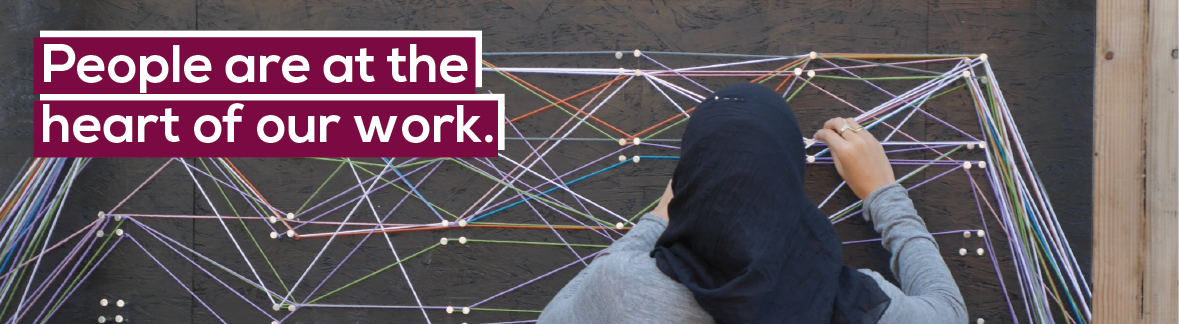
TYTHEdesign is a capacity-building firm that uses the lens of design and strategy to support clients across the social sector doing good in their communities. We help organizations connect with their stakeholders, drive innovation internally, enhance new and existing services, and share their story. Ultimately, we’re here to deepen existing skills and strengthen the impact of your work. 

MISSION

Our mission is to democratize decision-making and help our clients across government, nonprofits, and foundations build their capacity to create more equitable, scalable, and innovative strategies, programs, and services for their stakeholders and communities. We utilize human-centered design, accountable collaboration, and civic-based engagement practices that allow us to bring traditionally marginalized voices to the forefront, identify insights gleaned from community-based research, and ultimately achieve outcomes that define a Resilient City.

OUR DEFINITION OF RESILIENT CITY

A Resilient City is one that equitably addresses the current needs of its communities, while actively iterating to further meet future needs. Inspired by the UN Sustainable Development Goals, these needs include accessible and quality housing, food, health, education, and employment. The City is always evolving to sustain a sense of place and belonging for all residents, ensuring all people can adequately live, work, play, engage, and thrive. Simply put, a Resilient City promotes a just society. 

. 

We attribute the following social values as qualities of a Resilient City:

  • Civic engagement strengthens the community’s capacity for democratic participation through collaborative problem-solving and ownership over the decisions impacting it most.
     .
  • Nimble and responsive government is accountable to it diverse constituents, ensuring civic processes are transparent and recognize historical and political context across all communities.
    .
  • Economic vitality is driven from a diverse and innovative economy, supported by robust workforce development that challenges economic inequity. Key to that economic vitality is a sustainable economic model for social services, community-based organizations and institutions, small businesses, and corporations.
     .
  • All civic processes and social connectedness are built from an evolving socio-cultural context- a context that fosters a robust arts and cultural infrastructure where social capital is equitably accessible and accountable to the present demographics and needs of all people.
  • Technology enabled efforts are developed and implemented in response to community needs and insights. There is transparency in the intent for utilizing data, and residents hold agency over how their data is used. Access to technology is equitable and inclusive in respect to race, gender, age, ability and socio-economic status.
    .
  • The capacity for environmental resiliency is bolstered by community awareness and it acknowledges the need to address environmental impacts resulting from systemic racism. Beyond adapting and preparing for a changing environment, this capacity fosters a stable ecosystem while working toward a sustainable one, prioritizing long-term remediation and preservation over short-term economic gains. 

OUR STORY

TYTHEdesign was founded to both address social sector challenges and cultivate institutional and community resiliency. Conceived of during a trip exploring industrial manufacturing practices in India, TYTHEdesign was founded by Kristina Drury in 2010 in response to the lack of design in social sector work. Our work is grounded in the belief that design tools have great potential to create impact, build empathy, and solve human-centered problems. Since its inception, TYTHEdesign has created change through our facilitation and strategy in over 150 projects. 
 
Our name comes from the historical practice of “tithing”, or contributing a tenth of a harvest to support the community. Victor Papanek (1927-1999), a social designer and educator, believed the design industry could apply the same principles “by giving ten percent of our crop of ideas and talents to the seventy-five percent of mankind in need” (Design for the Real World, 1992:68). In this tradition, we routinely integrate pro bono work into our portfolio. Our name serves as a reminder of this commitment.